Popular Posts

Thursday, May 26, 2005

Torgny's Story -or- Things I learned From Torgny

Torgny is 95 years old and still working as a soil engineer in this area. He is spry with alert, blue eyes, an easy laugh, and a spattering of freckles that brings to mind Alfalfa from the Little Rascals. His parents came to this country from Sweden in the 1890's when they were about twenty years old. His father was a Swedish Methodist Minister and settled in central Texas, about 30 miles north of Austin, to serve the rural communities there. Torgny was born in 1910 the third of four boys.

He remembers life as a young boy in the pre-modern era. Danger and toil were ever present then, but so was wonder. His father served several churches in the area because the congregations were too poor to have their own pastor. So, Sunday morning he would preach at one church and Sunday afternoon another and so on. Sometimes these churches were as many as twenty miles apart and the only mode of transportation was horse and surrey. His father would sit on the front bench holding the rein with his two older brothers next to him and his mother would sit between he and his younger brother on the back bench with an arm around each of them, holding on tight. The surrey had no rails and the traveling was bumpy. If the little ones were to fall asleep they could topple right out.

"When I think of my mother..." Torgny lets escape a crushed sigh and shakes away tears at her memory when telling how it was.

Do you think times were better back then? Would you ever want to go back to the way things were when you were a little boy, I wondered.

"No. You wouldn't want to go back to that." He doesn't hesitate to answer. His speech is clear and his thoughts are lucid although his voice is faint as if his vocal chords have lost power somehow. "We have such tremendous advantages now, opportunities. Even the kids in those days were required to work. They were required to help the family, meet the needs."

Back then, he explained, Texas was mostly agricultural and the crops were mostly cotton. Farmers grew cotton until the soil wouldn't support it anymore and then they planted soybeans. Children 8, 9, 10, years old were expected to pick and chop cotton. This was grueling, bone aching work. If you stood you had to remain hunched over to pick the cotton out of the bowls and if you kneeled, well, each row was about 100 feet long and you better be sure to be wearing leather pads. Either way put a substantial strain on the body. That's men's work, or work that'll make a man, I thought. Back then children worked hard and grew up when still young. Now, kids play lazily and are lucky to reach adulthood by middle age.

But when he remembers the tremendous value an apple had back then or how rare ice-cream was he is glad to have experienced life when it was so simple. He tells of the first time he ever saw an airplane. He was twelve and word had gotten around that a plane would be flying over his town and landing in a certain dairy farm. The whole town came out to the field to see the plane land. Life went from nothing, as he described it, to everything.

When he was thirteen his father moved the family up around Chicago where he's lived ever since. He received his master's in civil engineering from Armour's Institute of Technology named after the man who made his fortune in meat packing. Today it is known as Illinois Institute of Technology. In 1935, he married Lillian, then 23. Today they have been married for 70 years.

"I'm so glad I have a spouse. " He tells me. "I can't stand the way people get divorced now days." I can only agree.

In his life he has worked for the railroad, as an engineer for Douglas aircraft during the war, run a turkey farm, and built about a dozen churches in and around Chicago. It was while building churches that Torgny discovered his avocation: whittling.

The Albanian Orthodox Church he was building wanted their chancellor furniture to be carved. So Torgny hired someone trained in Sweden in the craft of wood carving to do the job and was fascinated by what he saw. He asked the man if he would sell him some tools to get started and when the man did, Torgny had a craft. Perhaps not skill, not then, that would come later. But he had a craft and it would become part of who he is. Today he has dozens of chisels most of which are made in England. Among them are the ones he first received from that Swede long ago.

Tupelo wood is the medium he works in. Water Tupelo is a swamp tree with an attractive cream-colored wood that grows down south. Torgny likes it because the surface shows almost no grain and so doesn't interfere with the delicate details he invests into every piece and because he can carve it to a fine point, such as found at the end of the beak of a sparrow, and it will not break off. The scientific name for Water Tupelo means, "water nymph." There is indeed a goddess trapped in the core of the wood, her spirit it beautiful, and Torgny calls her out.

"I started out with ducks." He explained. "And then I shifted over to birds. I like them better." I wondered why. He squirmed in his seat in an attempt to verbalize something that he primarily understood viscerally. Finally he threw up his hands. "I don't know." He said. "I think they're prettier." And then he laughed heartily at his admission. And this truth came shining through to me: God made man to be moved by beauty.

His artist loft is a large, square room with brown linoleum floors and tan walls, an addition put onto the home just for his passion, this past time of his. Tools hang on magnetic strips against one wall and consume half his desk that is pushed into a corner of the room. Half finished birds line shelves behind his desk. I assumed these were the ones he was working on but learned that he was unhappy with them for one reason or another. I noticed that he doesn't destroy them or rid of them, but puts them behind him where he doesn't have to look at them while working. Every so often he'll go back to the reject pile, pluck one up and redeem it, making something beautiful out of what was a mistake. The verse, "And the grace of God makes even my mistakes to prosper," comes to mind and I think it is the God kind of creativity that an artist exorcises when he makes good out of something that went bad. Against three walls are shelves with his finished pieces. They are crowded together like a large family posing for a picture at a family reunion. My camera can not capture all of them in one frame. They are too many. Collectively they are a splendid display. Individually they are priceless in intricate detail and unique character.

I wonder why he's kept at it for so long. "What do you love about it?" I ask. He answers immediately seemingly certain of what drives him.

"I guess it's the satisfaction of doing what you set out to do 'cause I'm never satisfied with any one of 'em that I've finished." I am startled into laughter by his confession.

He pauses as his eye searches the room and finally gestures towards a hummingbird he's just completed. It's wings are pulled way back, suspended in flight, and it's needle-nose beak is thrusting into a trumpet shaped flower to draw nectar. He captures the motion and energy of the moment spectacularly.

"No. I don't like this. You say, 'Oh, why don't you like this?'" He asks himself the question and answers, "Well, in the first place I think this is too heavy and too thick." He is pointing to the stem of the flower. "And my kelly green should have some brown in it." Again, referring to the stem. He shakes his head, bothered by the flaws. "No. I'm not happy with this but the composition satisfies me. This is the composition that I like. But I guess if you were to be satisfied with what you do you wouldn't do it anymore."

His conclusion strikes a chord that resonates loudly within me. It is a revelation to me. I am a person who struggles. I am not satisfied and that is why I seek out my art, my craft. Torgny understands this and is at peace with this. He has made me to understand, too.




Tuesday, April 12, 2005

The Fairie Pipe


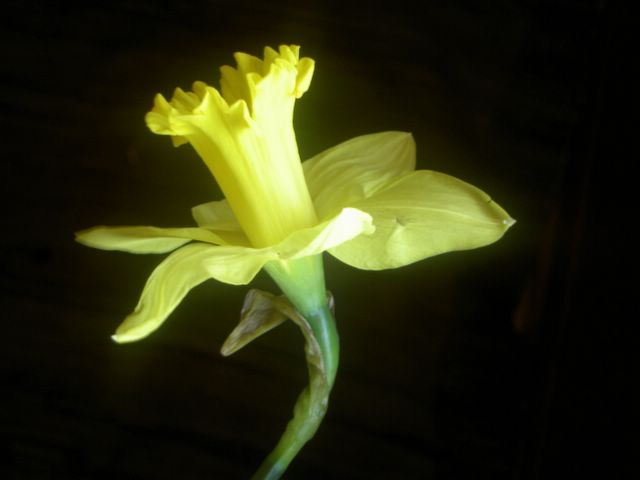
A daffodil and fairie pipe Posted by Hello

This is a daffodil from my garden but it also doubles as a smoking pipe for lazy house elfs. I know because I caught one puffing from it the other night.

It was late and everyone was sleeping. And I, being depleted of dreams and exhausted from the hard work of trying to fall to sleep, got myself up to fix a cup of warm milk. And that's when I heard it. The unmistakable crystalline sound of fairie laughter.

Being right tricky myself and compelled by curiosity, I slithered like a thief into a corner of our family room that was cast in blackest shadow. From there I took in a long sip of the pudgy, little fellow with apple cheeks and scraggly, white beard that grew to his knees, witnessing with my own eyes his daffodil foible.

He hopped onto the stone ledge of my fireplace letting his legs swing freely, back and forth, beneath him. From his pocket he pulled out a wire tool that I didn't think looked like much. But with one adroit twist and then jab of his wrist he gutted the stem of my daffodil creating a perfect tube for a pipe. After he removed the stamen with his fingers, much like you or I would clean out the heart of an artichoke, he carelessly threw the flower parts on my floor leaving yellow dust all over an otherwise clean surface.

That was the first mistake that little fool made.

Humming an elfin song, he took from a silk pouch what looked like ordinary tobaccy and firmly packed the steep daffodil cup, lighting his pipe with fire that shot out from his fat, little pointer finger.

But the smoke that rose from the pipe was the color of lilacs blooming in the garden and possessed the quality of light. And with each puff the little fool grew more and more wanton and buffoonish. It became clear to me, being knowledgeable about the ways and customs of the flower people, that this tobacco was anything but ordinary.

That jolly idiot is practicing magic in my house, uninvited, I said to myself. And this when he was supposed to be washing my floors and folding the laundry! Fuming in the corner and stunned by the rude behavior of my fairie intruder, I had it in me to brain him on the spot and teach him a lesson good. But I found myself transfixed by his oddness and littleness, and for reasons unknown to me could not take my eyes off him, nor move to hurt him.

So I watched as the elf puffed away. And with each puff he grew more silly, giggling and snickering all to himslef, celebrating himself in a horrible poem, and dancing a queer jig. Finally, when I surmised that the tobaccy was all smoked away, the daffodil itself began to burn. The fairie smoked the flower from the top of the petals to the end of the green stem until nothing remained but ashes. When the messy, little creep ground the ashes into my hearth rug, I found my ire.

Leaping out from under the cover of darkness I grabbed that round fellow by the ankles and shook him till his tiny teeth rattled inside his head.

"I'll not have you cavorting and what not in my house if you"ll not earn your keep. You'll do well to tithe next time you think to throw yourself a merry little, fiarie party on my hearth."

He turned himself around and looked hard at me, square in the eye. His ice blue eyes turned red and flamed and his teeth became strangely wolf-like. He rattled off something in an ancient language I felt certain was a spell, and a nasty one at that. But I, being a daughter of the first Adam and covered in the blood of the second Adam, was impervious.

"Ha!" My defiant laugh infuriated him and I took pleasure from that fact. Holding him by the back of his pants I opened my back door and threw the bugger out. I watched by moonlight as he ran howling and cursing in Gaelic into the thick of the wood.

I can't stand sloppiness in a fairie, won't tolerate it.

I haven't seen hide nor hare of him since. But sometimes, at twilight, I catch a glimpse of a curious, lilac colored smoke rising above the tree tops in the wood.

By C. C. Kurzeja
2005 All Rights Reserved

Thursday, March 31, 2005

Signs of Spring

A leisurely walk to the end of the block with my children and their red wagon. Wearing no coats or sweaters, we were hot even with the wind that raced continually past us on its endless journey southward.

A downy, gosling feather, smoky grey with tan fringes, captured by the bark of dead wood lying amidst last years fallen oak leaves, gently removed by my daughter and kept as a treasure in her collection.

The constant trill and chatter of busy birds nesting in the canopy of tree branches above us. The busyness, in general, of all the woodland and prairie creatures.

Cotton fingernails budding on the slender, drooping branches of my towering willows. They are a splendid lady, swishing her fine frock and swaying her ample hips as she waltzes with the wind, full of feminine sensuality and proud of it.

A bee sting, a welt the size of a blueberry with a bright pink center, on the bare bum of my son who sustained the injury while passing water in the bushes.

Green spears cutting through black soil, as daffodils, tulips, and daylillies wake from icy slumber and seek the sun.

A rain shower with small, scattered, gun smoke clouds casting dark shadows over there, but leaving a pitcher full of sunshine pouring down on the ground in a giant gush, splashing puddles of glistening light over here.

The result was a remarkable rainbow. And this, just when current events had cast me so low that I was having a hard time looking up. Just when my heart had dried up within me and turned my tears to ashes over this Terri, this Precious Braveheart, that sweet baby, who, being condemned to die of starvation though innocent, drank heartily from Christ's cup of suffering before withering away; God sent His sign and I was surprised by joy.

O wondrous love that watches over me. You overwhelm my days with good. O wondrous love that will not let me go.

The rainbow shone like gemstones, like yummy sherbet bands, only luminescent, in every flavor and waxed unbroken from one end of my property to the other arching high into the bruised sky. Above it was an echo, a larger rainbow, less brilliant and broken but almost heralding the brilliance of the other. They were royal brothers, half-deities, leaving their celestial thrones for a rare, earthly procession.

As night approached, the temperature dropped suddenly and the constant clanging of the chimes hanging outside my kitchen window alerted me to the rowdy weather that was on its way. From the west a herd of buffalo, in a line of thunderheads, charged with their heads down, kicking up dust and shaking the ground beneath them. With them came hail, and lightening, tornados, and strong winds.
I love a rainy night. Ooh,ooh. I love to watch the thunder and the lightning as it lights up the sky. You know, it makes me feel good.
With the morning came a return to wintry weather and news of Terri's death. Both were welcome.
by C.C.Kurzeja
2005 All Rights Reserved

Monday, March 28, 2005

Traditions

I had been married a few short months when my husband and I shared our first Easter together. With my family in California, we spent the afternoon with his.

My husband is fifteen years my senior and he is ten years younger then his closest brother. The result being, as I stepped into my in-laws kitchen, was that I was surrounded by old people.

"Oh, good." My brother in law, who looks a lot like the banker on the Monopoly game board, said when he saw us. "You're just in time for Grandma's Polish soup."

"What's that?" I asked innocently. I had no reason to be suspicious. Our families had a long history that began over a breakfast of pancakes, fresh squeezed orange juice and bacon. I knew my brother-in-law was a great cook.

"It looks gross, and it sounds gross, I know," began my husband, "but it tastes great."

"What's in it?" I asked with growing skepticism.

"Just try some." Was my brother-in-law's cagey response.

"After you tell me what's in it."

Looks were exchanged all around the room.

"Well, you start with chicken soup."

"You know, just plain chicken soup." My husband, sounding defensive, looked at me like I was supposed to respond. "Chicken soup."

"I got it."

"Then you add polish sausage, chopped hard boiled egg and chunks of rye bread."

"Without caraway seed." My husband clarified. "Seedless Rye bread." The way he said it suggested the whole soup would be ruined by the presence of that seed, but it was hard for me to imagine the soup wasn't ruined already.

"And then you top it off with horseradish." My brother-in-law said, setting steaming hot bowls down on the kitchen table. "It's delicious."

My in-laws began to slurp it up like wolves sucking marrow out of a bone.

"Why do they call it Polish soup?" I asked.

"I don't know." Replied my brought-in-law with a shrug.

"No. I mean: Where does it come from? Is this an ancient soup served among the royal line? Did it originate with the peasants in the countryside? Was it a result of communism? Why is it Polish?"
"I think Grandma just made this up herself." My mother-in-law added. "The boys just always called it Grandma's Polish soup because she's Polish and she's the only one who made it."

"Oh." I stared at the steaming soup placed before me like my death was at the bottom of the bowl.

My mother-in-law sensed my trepidation. She is a little, robust Italian lady with lips like the curl at the tip of a rose petal, skin like chilled cream in a porcelain bowl, and light chocolate truffles for eyes. A perpetual frown announces her sanguine personality and a shrug of her shoulders coupled with upturned hands could mean any one of a million different things. It's her language.

"When I first got married. I thought this soup was weird." She did her shoulder/hand thing. "But I ate it. And year after year," she shrugs again, "I started to, you know, get accustomed to it. And you will too, get accustomed to it."

Like heck I will!

It was as if, in that moment, sitting at that table surrounded by my new family who also happened to be old friends, with the diffused Spring light coming in from the window catching dust and cat hair in it's streams, with noses running from the horseradish being patted and wiped, and with the sound of hot soup being sucked off a spoon ringing in my ears like ocean waves, my mother in law pulled back the curtain and showed me my future.

I tried, honest I did. I psyched myself up, and then backed down; psyched myself up and then backed down. Finally, I just gave up.

"It looks great. If I weren't a vegetarian I'm sure I'd love it, but I just can't bring myself to eat meat." I said as I gently pushed the bowl away.

It's been eleven years, and I haven't been a vegetarian since before my first child was born, but I have yet to bring a spoon of Grandma's Polish soup to my lips. Although, I have managed to get it half way between my chest and my chin before backing out on several occasions. And while I may never learn to appreciate that soup, it remains a very important part of the way my husband and his family celebrate Easter.
by C.C.Kurzeja
2005 All Rights Reserved


Tuesday, March 01, 2005

My Why

I ran across this little ditty as I was cleaning out my files. I wrote this for an assignment I was given in a script writing class I took over the internet. The intent was to help us grasp the concept of "why" in a movie, what it's all about, or the reason behind it. I thought I'd put it out there for public consumption before deleting it forever.
A little background is needed in order to put my assignment into context. Richard is the instructor as I've already stated and Judith was my sole classmate. Richard had submitted his "why" as an example for us to look over. His was several pages long, began hundreds of millions of years ago in the primordial swamp and was imbued by post modern thought.
Don't try to sing this though, you'll only end up hurting yourself.

Dear Richard,

You are very philosophical and complex and I am not. "See to it that no one takes you captive through philosophy and empty deception, according to the tradition of men, according to the elementary principles of the world, rather than according to Christ." I've been taken captive according to Christ. I'm sure you'll find me to be simplistic. But if you want to know my heart and soul, here it goes.

Why? Because He first loved me, as the song goes. I am because I am thought me, and before the foundations of the earth were laid, predestined me, and called me according to His purpose, and justified me and glorified me.

I cannot over emphasize this: I am a person deeply changed be the love of God in Christ Jesus. I have been touched by a heavenly Father who, "watches me with His eye upon me, and instructs me and counsels me in the way I should go." He heals my deepest wounds, and He restores my soul. I love Him. I simply cannot talk about the depth of the riches of His grace towards me in Christ Jesus, or His abundant mercy towards me, or the gentleness of His rod of correction on me without crying. This sounds totally corny to you, but it's true.

And my why animates my every thought and deed. I am compelled by the love of God and I am not ashamed of the Gospel of Christ for it is the power of God unto salvation, first for the Jew and then for the gentile. I can attest to that power.

I live to "glorify God and enjoy Him forever" as the Westminster Shorter Catechism goes. I didn't write it, but I own it. I've adopted it and it is my purpose.

But it is only my broad purpose. I am persuaded by scripture that I have a distinct purpose, that God created me with talents and interests for a reason. For: "...you are His workmanship...created...for good works, which God prepared beforehand so that we would walk in them." And, "I know the plans I have for you, declares the Lord..." And, "Show me the work of my hands, O Lord. Yes, confirm to me the work of my hands."

And so exploring my talents, using my creativity is an act of worship for me. And being known by you and Judith and knowing you and Judith is acting in the very image of God. It is an act of love.

And love is my ultimate truth.

And so that's my why. What's yours? Do tell.